How Morning Brew Turns Audience Data From 4M+ Subscribers Into Sales Intelligence
With roughly 95% of its revenue coming from advertising, Morning Brew uses a Mastra-powered internal platform to bring company, competitor, and audience research together for its revenue team.
Weeks → minutes
Sales pitch research time
~95%
Of revenue comes from advertising
Morning Brew is a multi-channel media company with over 20 content franchises across newsletters, podcasts, video, and social. The company generates $70 million in annual revenue, with about 95% coming from advertising.
Producing a sales pitch for an advertiser used to depend on an weeks-long manual research process run by Morning Brew's data and insights team. Now the sales team can generate these insights in minutes using an internal Next.js application powered by Mastra workflows.
Going from manual research to agentic workflows
Morning Brew's advertising business is fully partnership-based, where sellers and account managers work with agencies or end customers directly. They need to understand where each campaign belongs and why it's the most relevant to that specific audience.
The company's flagship Morning Brew Daily newsletter reaches more than 4 million active subscribers. Over the past decade, they have accumulated a ton of opt-in first-party audience data they could get insights from.
In the past, there was a lot of manual work going into sales pitch preparation. The data and insights team would spend weeks understanding the company and its competitors, checking whether Morning Brew had worked with similar companies before, and finding relevant evidence in their internal reader survey data.
Those pieces then had to be pulled together into useful talking points for outreach or a sales call.
The engineering team at Morning Brew decided to build a Mastra-powered sales intelligence platform that would reduce this process from weeks to minutes. It now supports prospecting, sales calls, and campaign planning.
The sales intelligence platform architecture
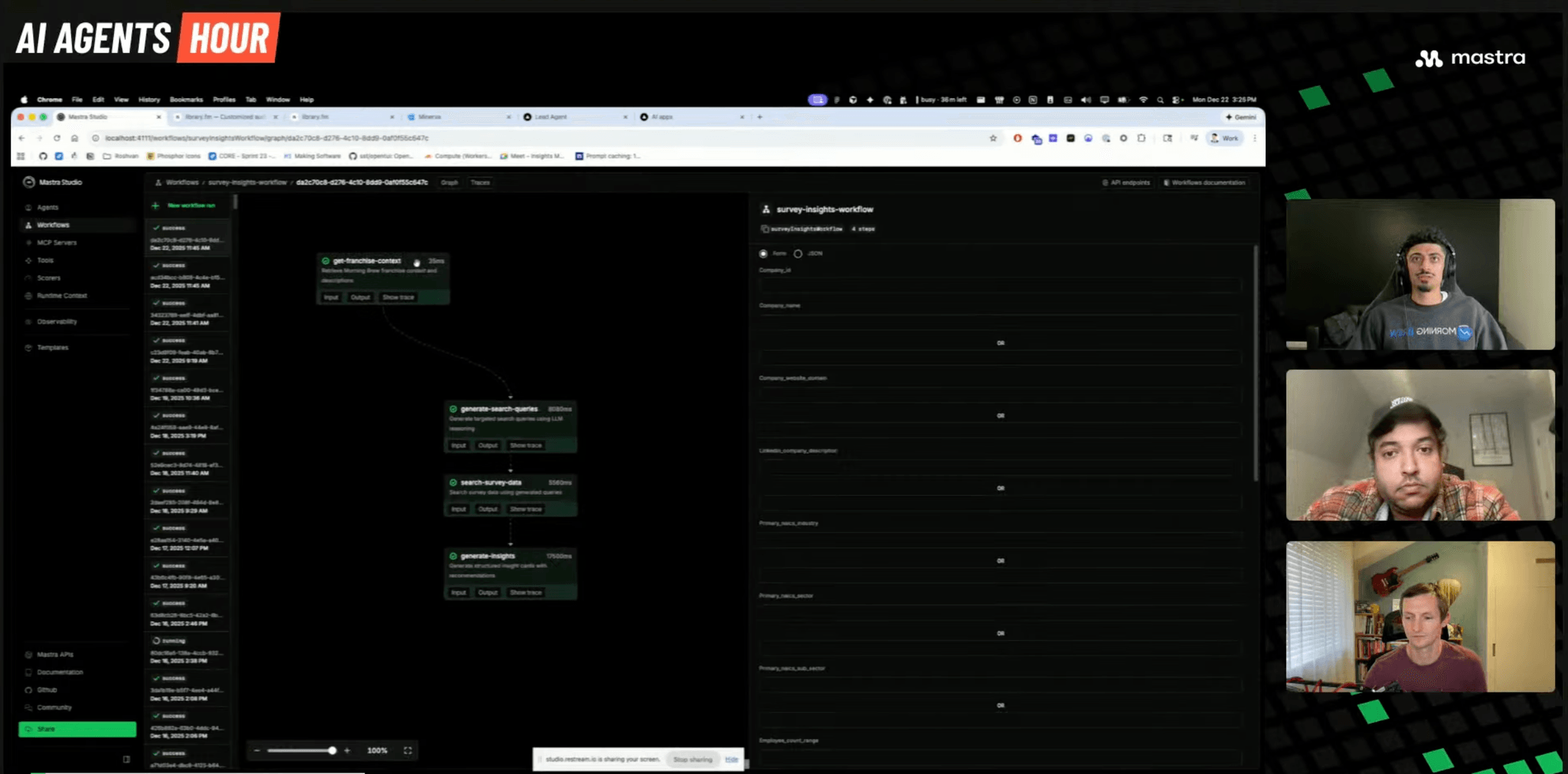
The sales intel application uses Next.js for the interface and Mastra for agent and workflow orchestration. Its production architecture consists of three workflows and two tools.
Company lookup and enrichment: Before the Mastra workflows run, the application retrieves general company information and relevant contacts from external and internal sources and enriches the data.
Then the competitor research workflow pulls competitors from an external company-data provider, asks an agent to find additional competitors, and merges the two sets.
The franchise context tool retrieves information about Morning Brew's brands and how each one relates to the prospective advertiser.
The prompt insights workflow combines the company, competitor, and franchise context into potential sales insights.
Finally, an agent generates targeted search queries, and the survey vector tool searches Morning Brew's survey database for relevant first-party findings.
The output is a "Key insights" page. The seller then uses these insights to prepare a more specific pitch.
Mastra agents run inside individual workflow steps. Deterministic code handles data retrieval and merging; agents handle open-ended work like competitor expansion, query generation, and synthesis. A RAG pipeline connects the insight workflows to Morning Brew's survey data without loading the entire dataset into the prompt.
With that separation, the team has control over where model judgment is useful and where ordinary application logic is more reliable.
A game changer for Morning Brew's engineering team was when Mastra released Studio. It gave people outside engineering a way to see agents in action, and made cross-team collaboration much easier.
"When the more PM-centric Studio came out, where you could give people access and they could see the agents running and see the workflows running, it kind of opens up folks' eyes who are maybe not in code to see what your representation of code looks like in an agent and workflow." — Roshvan Chalkey, Senior Software Engineer
What's next
Morning Brew plans to connect the sales platform more deeply to its revenue stack, including automatic lead ingestion and integrations that can push research into Salesforce or HubSpot. The team is also working on stronger observability and evals around the generated insights.
Its next internal AI project is a permission-aware Core Intelligence Layer for company-wide questions. It would check what the employee can access and use an orchestrator to judge whether the result answers the question.