You have automation that runs on rules, chatbots that answer questions, and generative models that produce text on demand. None of them can plan a five-step workflow, recover from a failed API call, and adapt their next action based on what they learned in the previous one. That gap between “it runs” and “it reasons” is where agentic AI tools operate.
A spring 2025 survey from MIT Sloan Management Review and Boston Consulting Group found that 35% of organizations had already adopted AI agents, with another 44% planning near-term deployment. The practical details of what these tools do, how they compare to existing approaches, and what it takes to ship them reliably are less straightforward.
This guide covers what is agentic AI at a practical level, the architectural patterns behind these systems, how they differ from both traditional automation and generative AI, and what your team needs to monitor and evaluate them in production.
What are agentic AI tools?
Agentic AI tools are software systems that pursue goals through autonomous reasoning, planning, and action. Rather than waiting for your prompt at each step, they perceive their environment, decompose objectives into subtasks, execute those subtasks using external tools, and adapt their plan based on intermediate results.
The word “agentic” signals that the system has agency. It can decide what to do next rather than following a fixed script. At its core, each agentic system uses natural language processing and NLP techniques to interpret unstructured inputs before routing them to the reasoning layer.
This makes these tools fundamentally different from static pipelines or single-turn model calls.
Key components that make AI tools “agentic”
Your system qualifies as agentic when it combines several capabilities into a closed loop. These are not optional add-ons but architectural requirements.
-
Perception: the agent gathers inputs from APIs, databases, user messages, or real-time data streams and converts them into a representation it can reason over
-
Reasoning: a model interprets the inputs, evaluates options, and selects a plan of action, often using chain-of-thought or tree-of-thought techniques
-
Tool use: the agent calls external functions, such as search APIs, code interpreters, CRM writes, or database queries, to execute steps in its plan
-
Memory: short-term context (what happened earlier in this conversation) and long-term storage (what the agent learned across sessions) let the agent maintain coherence
-
Feedback and adaptation: the agent evaluates the outcome of each action and adjusts its next step, which is the core loop that separates AI agents from one-shot generation
How agentic AI agents actually work in practice
Your agent does not run in a single pass. It enters a loop that cycles through reasoning, action, and observation until it completes the task or hits a termination condition.
Mastra agent node diagram: the perceive-reason-act loop where an agent evaluates inputs, selects a tool call, observes the result, and decides whether to continue or return a final answer.
Consider a code agent that receives the goal “find and fix the failing test in this repository.” It reads the test output (perception), identifies the likely root cause (reasoning), edits the source file (tool use), re-runs the test suite (action), and checks whether the test passes (feedback).
If the fix fails, it loops back and tries an alternative approach. This multi-step, self-correcting behavior is what separates AI agents from a single completion.
How agentic AI tools differ from traditional automation
You have probably used robotic process automation (RPA) or rule-based workflow engines. Those systems excel at high-volume, deterministic tasks where the input format and business logic never change. Agentic AI tools solve a different class of problem, one that traditional automation and even intelligent automation platforms were not designed for.
Beyond rule-based systems: why traditional automation falls short
Your RPA bot, whether it runs on UiPath or a custom script, breaks when a webpage layout changes or when an input falls outside the rules you defined. It cannot reason about new situations, call a model for judgment, or recover gracefully from an unexpected response.
Tools like UiPath handle the 80% of tasks that are predictable and repeatable, but they stall on the 20% that require contextual judgment.
The cognitive leap: how these tools think and adapt
Your agentic system maintains a model of its current situation and uses that model to decide what to do next. When a tool call returns an unexpected error, it can re-plan. When user requirements change mid-workflow, it can adjust.
Some agent architectures also incorporate reinforcement learning and deep learning techniques to improve tool selection and planning accuracy across runs. This adaptability comes from the reasoning layer, typically a language model, that evaluates options before committing to an action. The table below summarizes the structural differences.
| Dimension | Traditional automation (RPA) | Agentic AI tools |
|---|---|---|
| Decision logic | Fixed rules and decision trees | LLM-based reasoning with dynamic planning |
| Input handling | Structured, predictable formats | Unstructured text, images, and mixed data |
| Error recovery | Fails or escalates to a human | Re-plans and retries with alternative approaches |
| Multi-step workflows | Hardcoded sequences | Dynamic task decomposition |
| Learning | None without manual reprogramming | Adapts through feedback loops and memory |
What is the difference between agentic AI and generative AI?
You can think of generative AI as the engine and agentic AI as the driver. Generative AI, including large language models like ChatGPT and models from Anthropic, creates content in response to a prompt. It produces one output and stops.
Agentic AI uses that same generative capability as one component inside a broader system that plans, acts, and iterates.
Generative AI answers “write me a deployment script.” Agentic AI goes further: it writes the script, executes it against a staging environment, checks the logs for errors, fixes the issues, and re-deploys.
The distinction is not about the model itself but about the architecture around it. LLMs provide the reasoning layer, but the agent framework provides the loop, the tool integrations, and the memory that turn a single completion into a sustained workflow.
| Dimension | Generative AI | Agentic AI |
|---|---|---|
| Execution pattern | Single prompt, single output | Multi-step loop with reasoning and action |
| Tool integration | None (generates text only) | Calls APIs, databases, code interpreters |
| Error handling | Returns output regardless | Evaluates outcomes and retries |
| Memory | Stateless between calls | Maintains context within and across sessions |
| Autonomy | Responds to human prompts | Pursues goals with minimal human intervention |
Types of agentic systems
Your choice of agent architecture depends on the complexity of the task and how many specialized roles the system needs. Most fall into one of five categories.
Frameworks like LangChain, LangGraph, and CrewAI are popular in the Python community, while TypeScript-based options serve teams that want to stay in a single runtime. Platforms like Relevance AI and Microsoft Copilot Studio offer lower-code approaches for teams that prefer configuration over custom code.
Single-agent task executors
You deploy a single AI agent with access to a defined set of tools. It handles one goal at a time, like a code agent that reads a GitHub issue, writes a patch, and opens a pull request. Single-agent systems are the simplest to build and debug because you only have one reasoning loop to trace.
Multi-agent orchestration systems
You split complex work across multiple specialized AI agents that collaborate through message passing or a shared state. One agent might handle research, another drafts content, and a third reviews it for accuracy.
Multi-agent systems scale to problems that require diverse expertise, but they also introduce coordination overhead. Frameworks like CrewAI and LangGraph provide built-in primitives for defining agent roles and routing messages between them.
Mastra network diagram: a coordinator agent routing scoped work to specialist agents, then aggregating their results.
A customer support pipeline might use one AI agent for intent classification, another for retrieval-augmented generation against your knowledge base, and a third for drafting and sending the response.
Workflow automation platforms
You define multi-step workflows as code or configuration, and the platform handles execution, branching, retries, and error handling. Agentic AI platforms like Relevance AI and Microsoft Copilot Studio sit between pure agent frameworks and traditional workflow engines, giving you model-powered decision points inside a structured pipeline.
Retrieval-augmented and memory-equipped agents
You pair your agent with a vector store, a retrieval pipeline, or a persistent memory layer so it can ground its reasoning in your actual data. Retrieval-augmented generation prevents hallucination by giving the model verified context to work with.
Data quality in your retrieval pipeline directly affects agent accuracy, so cleaning and structuring your source documents is a prerequisite, not an afterthought. Memory-equipped agents maintain state across sessions, so a user can continue a conversation days later without re-explaining the setup. This guide to agent memory walks through storage, vector search, and context management in more detail.
Brand compliance and governance agents
You deploy AI agents whose sole job is to review, audit, or enforce policy on outputs produced by other agents or humans. These agents check content against brand guidelines, flag regulatory violations, and ensure consistency across channels. They act as guardrails inside a larger agentic system.
Best agentic AI tools for engineering teams
The architectural patterns above show up in a handful of named frameworks and platforms you will actually evaluate. The options below split into two groups: frameworks you code against directly, and platforms your business teams can run without engineering support.
Building autonomous agents with Mastra
Mastra agent framework visual: a TypeScript-native stack connecting agents, tools, workflows, and memory in one runtime.
Mastra observability preview: span-level traces for model calls, tool invocations, latency, and token usage across an agent run.
Your team needs a framework that handles agent orchestration plumbing so you can focus on product logic. Mastra is an open-source TypeScript framework (Apache 2.0) for building AI agents with workflows, memory, model routing across 90+ providers, and built-in observability.
You define agents once, chain workflow steps with branching and retries, and expose tools through a standardized API. Mastra also supports MCP servers that expose agents, tools, and resources, and you can deploy to Vercel, Netlify, Cloudflare, or standalone Node.js servers.
Pros:
-
TypeScript-first agents, workflows, and memory in one framework
-
Model routing across 90+ providers through one interface
-
Native tracing and evals for production debugging
Trade-offs and limitations:
-
TypeScript and JavaScript only, so Python-heavy teams need another stack
-
Younger community than some long-running Python frameworks
-
You still own model spend, hosting choices, and governance policy
Build your first autonomous TypeScript agent on Mastra.
Developer frameworks for building agents
These frameworks give you direct control over agent logic, state, and tool calls through code rather than a visual builder.
AutoGen
AutoGen is Microsoft’s conversational multi-agent framework, where agents exchange messages, debate, and negotiate to reach an answer rather than following a fixed graph or role structure.
Strengths:
-
Conversation-based design fits use cases like code review, research synthesis, and brainstorming, where multiple perspectives improve the result
-
Large open source community and one of the most widely starred agent frameworks
-
Flexible for exploratory, research-style agent interactions
Trade-offs and limitations:
-
Steeper learning curve than CrewAI for teams new to multi-agent design
-
Microsoft has shifted primary development focus to its broader Microsoft Agent Framework, so new projects should confirm the migration path before committing
-
Python-only, with no native TypeScript support
Best for: Research-style workflows such as code review or brainstorming, where you want agents to challenge each other’s conclusions.
Vercel AI SDK
Vercel's AI SDK is a TypeScript toolkit for calling models, streaming responses, and defining tools an LLM can invoke. It's the foundational layer that some higher-level frameworks, including Mastra, build on top of.
Strengths:
-
Unified, provider-agnostic API for calling and streaming from many model providers
-
Lightweight and framework-agnostic, drops into any Next.js, React, or Node.js project
-
First-party UI hooks that wire model output directly into frontend components
Trade-offs and limitations:
-
No built-in agent memory, workflow orchestration, or observability layer, so multi-step agents require you to build that structure yourself
-
Functions more as a building block than a complete agent framework
-
Younger agent-specific feature set than frameworks purpose-built for orchestration
Best for: Teams that want direct, low-level control over model calls and streaming, and are willing to build orchestration and memory on top themselves.
Microsoft Copilot Studio
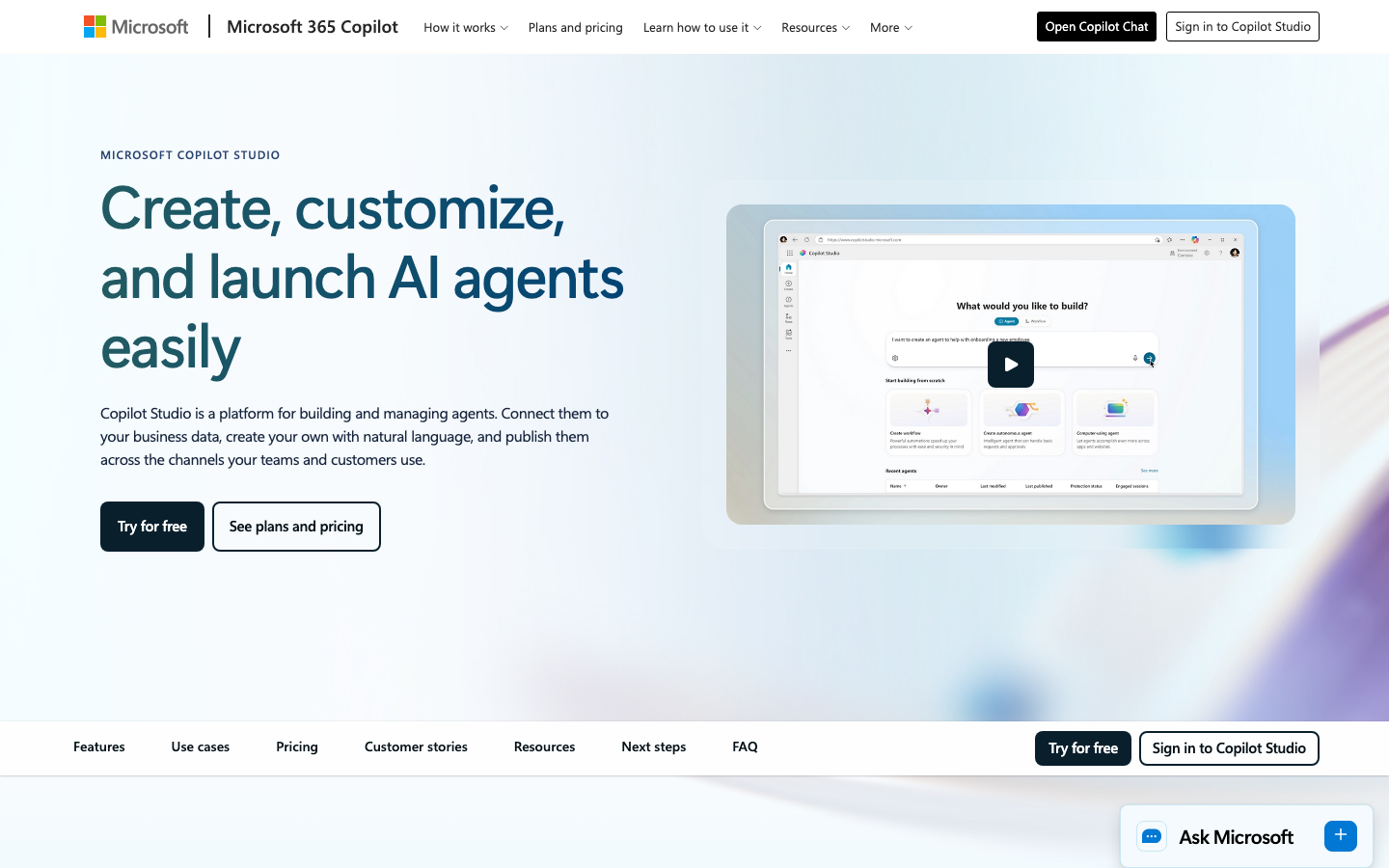
Microsoft Copilot Studio is a low-code agent builder integrated with Microsoft 365, Teams, and the Power Platform.
Strengths:
-
Business teams, not just engineers, can build and deploy agents
-
Deep integration with Microsoft 365, Teams, and Power Automate
-
Fast time to production for teams already standardized on Microsoft’s stack
Trade-offs and limitations:
-
Most powerful within a Microsoft-centric stack, less flexible outside it
-
Advanced flows and premium connectors require higher-tier licensing
-
Less suited to highly custom agent logic than a code-first framework
Best for: Microsoft-centric organizations that want non-technical teams building and deploying agents inside tools they already use.
LangGraph
LangGraph is a graph-based agent framework from the LangChain team, built for teams that need explicit control over state, branching, and long-running execution. You model an agent’s logic as nodes and edges in a directed graph, with checkpointing that lets a run pause and resume without losing state.
Strengths:
-
Explicit state management through a graph structure, with built-in checkpointing for long-running or interrupted workflows
-
Strong human-in-the-loop support for approval steps mid-run
-
Large ecosystem and community built around the broader LangChain project
Trade-offs and limitations:
-
Steeper learning curve than role-based frameworks, since you have to think in explicit graph states
-
Python-first, with no native TypeScript support, which matters if your stack is TypeScript end to end
-
More setup required before you see a working agent, compared to faster prototyping frameworks
Best for: Python teams building complex, stateful, production agent workflows that need durability and fine-grained control over branching.
CrewAI
CrewAI is a Python framework that lets you define agents as specialists, organized into a crew, that collaborate on a shared task. You assign each agent a role, a goal, and a set of tools, and CrewAI handles delegation between them.
Strengths:
-
Fast time to a working prototype, often in a few dozen lines of code
-
Intuitive abstractions (agent, task, crew) that mirror how real teams divide work
-
Active community and growing enterprise adoption
Trade-offs and limitations:
-
Less explicit control over execution flow than graph-based frameworks like LangGraph
-
Python-only, so TypeScript teams need a different framework or a service boundary
-
Can require more rework as workflows grow past simple role-based delegation
Best for: Teams that want a working multi-agent prototype fast and whose workflows split naturally into specialist roles.
Inngest AgentKit
AgentKit is Inngest's TypeScript framework for building AI agents, from single model calls to multi-agent networks that use tools. It layers agent orchestration on top of Inngest's durable execution engine, so long-running or multi-step agent runs survive crashes and retries without extra state-management code.
Strengths:
-
Built-in durable execution, so multi-step agent runs automatically resume after a crash or a deploy
-
Composable primitives for agents, tools, and multi-agent networks, with MCP support for tools
-
Local tracing and input/output logs through the Inngest dev server for debugging agent runs
Trade-offs and limitations:
-
Tied to the Inngest execution model, so adopting it means buying into Inngest's broader platform
-
Younger and narrower community than long-running frameworks like LangGraph or CrewAI
-
Best fit is teams already using or open to adopting Inngest for their broader job/event infrastructure
Best for: TypeScript teams that want durable, crash-resistant multi-agent execution without hand-rolling retry and state logic.
ElizaOS
ElizaOS is an open-source TypeScript framework built for autonomous social and character-driven agents, with a plugin architecture for connecting agents to platforms like Discord, Telegram, and X.
Strengths:
-
TypeScript-native, with a plugin system for adding platforms, model providers, and custom actions
-
Strong fit for persona-driven agents that need a consistent character across channels
-
Active open-source community, particularly around Web3 and social-agent use cases
Trade-offs and limitations:
-
Built around a narrower use case (social, character-based agents) than general-purpose orchestration frameworks
-
Smaller ecosystem than Mastra or LangGraph for general business workflows
-
Python-first RAG and data tooling from the wider ecosystem is less directly reusable here
Best for: Teams building autonomous social or character-based agents that need to operate consistently across chat platforms.
Enterprise platforms for deploying agents
If your team wants agents running inside an existing enterprise stack without writing orchestration code, these platforms trade some control for faster deployment.
Salesforce Agentforce
Salesforce Agentforce is built on Salesforce Data Cloud and Einstein AI, with an Atlas reasoning engine that orchestrates multi-step actions across sales, service, and marketing workflows.
Strengths:
-
Native access to CRM data without replicating it elsewhere, through Salesforce’s zero-copy data grounding
-
Pre-built agents for common front-office roles like sales and service
-
Atlas reasoning engine handles multi-step orchestration without custom code
Trade-offs and limitations:
-
Most valuable if you already run on Salesforce, less compelling as a standalone agent platform
-
Enterprise pricing and licensing model, which can be a barrier for smaller teams
-
Less flexible than code-first frameworks for highly custom agent logic
Best for: Teams already running on Salesforce that want agents grounded directly in CRM data without moving it.
UiPath Agentic Automation
UiPath Agentic Automation layers agentic reasoning on top of UiPath’s existing RPA bot estate, so agents can reason about exceptions that would previously break a deterministic bot.
Strengths:
-
Extends an existing RPA investment rather than requiring a rebuild
-
Strong fit for legacy-heavy industries like financial services, manufacturing, and logistics
-
Combines agents, bots, and human review in one platform
Trade-offs and limitations:
-
Highest upfront cost among the enterprise options here, including robot licenses and orchestrator infrastructure
-
Longest deployment timeline, often requiring a dedicated RPA center of excellence
-
Less suited to teams without an existing RPA footprint
Best for: Enterprises with heavy legacy RPA investment who want to layer agentic reasoning on top of their existing bots rather than replace them.
A side-by-side view of where each option fits:
| Tool | Type | Best for |
|---|---|---|
| Mastra | TypeScript framework | Full-stack agent development with built-in observability |
| AutoGen | Python framework | Multi-agent debate for research and review tasks |
| LangGraph | Python framework | Complex, stateful, production workflows |
| CrewAI | Python framework | Fast prototyping with role-based agents |
| Vercel AI SDK | TypeScript toolkit | Low-level model calls and streaming as a foundation to build on |
| Inngest AgentKit | TypeScript framework | Durable, crash-resistant multi-agent execution |
| ElizaOS | TypeScript framework | Autonomous social and character-based agents |
| Salesforce Agentforce | Enterprise platform | CRM-native customer and sales agents |
| Microsoft Copilot Studio | Enterprise platform | Low-code agents inside Microsoft 365 |
| UiPath Agentic Automation | Enterprise platform | Adding agentic reasoning to an existing RPA estate |
How to choose agentic AI tools
Your shortlist should start from the work you need done, not from a feature matrix on a landing page. Match the tool to your runtime, your observability needs, and the failure modes you can actually tolerate in production.
Score each option on language and runtime fit first. If your product is TypeScript, a Python-only stack adds handoff cost every time you ship. Next, inspect observability depth: you want span-level traces for tool calls and memory reads, not only request logs. Confirm model-provider flexibility so you can switch endpoints without rewriting agent code.
Then pressure-test workflow primitives. You need branching, retries, human-in-the-loop pauses, and clear error handling when a tool returns garbage. Check memory and context management for multi-session work. Finally, verify deployment targets (serverless, containers, edge, or self-hosted) and whether evals run in CI/CD before you scale a pilot.
| Criterion | What to evaluate |
|---|---|
| Language and runtime | TypeScript vs Python vs low-code configuration |
| Observability depth | Span-level tracing vs basic logging |
| Model provider flexibility | Number of supported providers and ease of switching |
| Multi-step workflows | Built-in branching, retries, and error handling |
| Deployment targets | Serverless, containers, edge, self-hosted |
| Community maturity | Documentation quality, active contributors, production references |
Start with one well-scoped pilot, instrument it with traces and evals, then expand only after you can explain every failed run from the audit trail.
Teams building agents in TypeScript can use Mastra when they want agents, workflows, memory, and span-level tracing in one open-source runtime instead of assembling those layers separately.
How organizations are using these tools today
Your team can learn from how early adopters are deploying autonomous AI agents across industries. The patterns are emerging quickly.
Automating content operations and digital asset management
You can use agentic AI tools to auto-tag digital assets, generate metadata from visual analysis, and route content through approval workflows without manual handoffs. These AI agents integrate with productivity tools like DAMs and CMS platforms to reduce the time between content creation and publication.
Intelligent personalization at scale
You define audience segments and business objectives, and the agent handles tactical execution: selecting content variants, optimizing send times, and adjusting targeting parameters based on real-time engagement data. This replaces the manual A/B test cycle with continuous, autonomous optimization.
Autonomous campaign and process optimization
You point an agent at a campaign performance dashboard and let it make micro-adjustments, like swapping creative, pausing underperforming channels, or shifting budget allocation, based on live metrics. Marketing teams using this pattern report significant reductions in time spent on tactical adjustments.
Enterprise workflow orchestration
You connect agents to your CRM, support ticketing system, and internal knowledge base so they can handle end-to-end processes like customer onboarding, issue resolution, or supply chain management.
Companies like Moveworks have built agent-based products that automate IT service desk workflows and employee support. Platforms like Moveworks and Google Cloud agent tooling show how enterprises are connecting AI agents to existing CRM and ITSM systems.
What business results can you expect?
Your return on investment depends on the complexity of the workflows you automate and how well you integrate agents into existing processes.
Measurable productivity and throughput gains
You can expect the biggest gains on tasks that involve many manual handoffs, data lookups, or repetitive decisions. Approval cycles shorten because the agent handles routing and follow-ups. Content velocity increases because agents draft, check, and publish without waiting for each human step.
Enterprise-scale operational improvements
You see compounding returns as you add more agents and connect them to more systems. The key metric is not just time saved per task but the number of tasks that were previously impossible at your team’s current headcount.
Autonomous systems handle demand spikes without hiring or overtime, which matters during seasonal peaks or rapid growth phases.
Monitoring, tracing, and evaluating AI agents in production
Your agent can return a successful HTTP response while silently hallucinating, choosing the wrong tool, or burning tokens on unnecessary retries. Traditional monitoring is not designed for this.
Why observability is harder with autonomous agents
You cannot treat an agent like a stateless API endpoint. Each agent run is a tree of decisions where one bad step can cascade into a completely wrong result.
The non-deterministic nature of LLMs means that identical inputs can produce different execution paths. You need tracing that captures every decision point, not just the final output. Standards such as OpenTelemetry give you a shared model for spans and context propagation across those multi-step runs.
Tracing tool calls, memory reads, and multi-step runs
You need structured traces that break each agent into a hierarchy of spans: the top-level request, each reasoning step, every tool call with its inputs and outputs, and any memory reads or writes.
Audit logs that record every tool call, model invocation, and decision branch give your team a full reconstruction of what the agent did and why. These audit logs become essential during incident review and compliance reporting.
Mastra span tree visualization: each span shows the operation type, duration, and parent-child relationship so you can pinpoint bottlenecks or failures in a multi-step agent run.
Evals, guardrails, and prompt injection protection
You should run evaluations against your agent before and after deployment. Evals test whether your agent produces correct outputs for known inputs, handles edge cases gracefully, and stays within your defined behavior boundaries.
Guardrails enforce constraints at runtime, like rejecting outputs that contain PII or blocking tool calls that exceed permission boundaries.
Human-in-the-loop checkpoints add another layer. For high-stakes decisions, require human approval before the agent executes irreversible actions. This pattern balances autonomy with control.
What to consider before implementing agentic AI
Your implementation will likely spend more time on data engineering, integration, and governance than on prompt engineering or model selection.
Technical requirements and integration challenges
You need clean data pipelines, reliable API connections to your existing systems, and infrastructure that can handle the latency and cost of multiple model calls per agent run.
Cloud platforms like Google Cloud and AWS provide managed infrastructure for hosting agent workloads, while services like Anthropic and Google Cloud Vertex AI offer model endpoints you can route through your framework of choice. Structured data formats help agents identify different sources and maintain consistency across tool calls.
Risks and governance considerations
You face real risks with autonomous decision-making. An agent that autonomously rejects a loan application or sends incorrect customer data needs the same accountability structures as a human making that decision. Key considerations include:
-
Explainability: can you reconstruct why the agent made a specific decision from its trace data?
-
Permissions: does the agent have least-privilege access to external systems, or does a compromised agent have broad reach?
-
Drift: are you monitoring whether the agent’s behavior changes over time as models update or data distributions shift?
-
Accountability: who is responsible when an autonomous AI agent causes harm, and how do you document that chain of responsibility?
Wrapping up
You now have a clearer map of what separates agentic AI from both traditional automation and single-turn generation. The value comes not from the model itself but from the architecture around it: the planning loops, tool integrations, memory systems, and observability layers that make autonomous behavior reliable and debuggable.